Hidden in the valleys of Galicia grow Europe’s ancient Atlantic rainforests, rare ecosystems rich in life.
Share This Post
Where can you find fragas atlánticas?
Galician fragas are temperate humid forests, also called temperate rainforests, oceanic forests or Atlantic forests. They are a very special and rare type of forest that only grows in specific and limited areas of the planet. In fact, temperate rainforests can only be found in oceanic moist regions around the world.
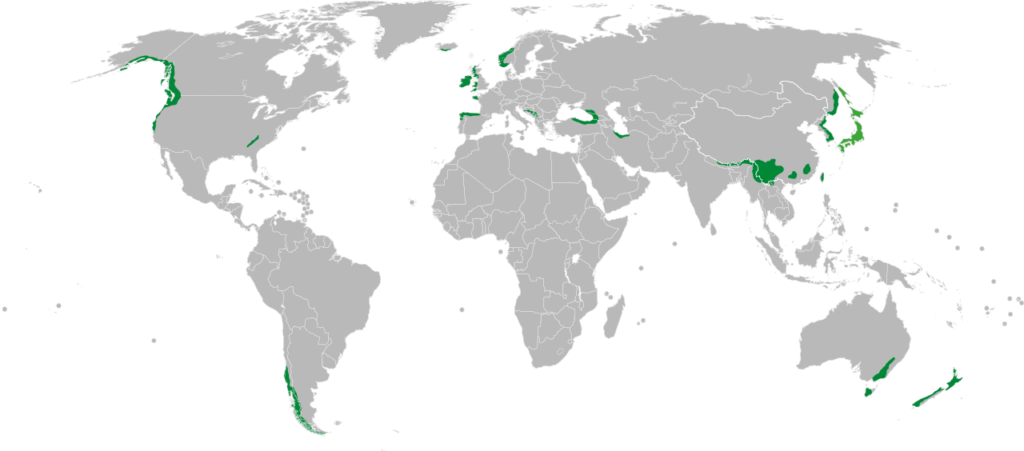
In Europe, temperate rainforests are found only in a handful of regions: southwestern Norway, western Great Britain, Ireland, Bulgaria, Serbia, and Galicia (see the map below). This makes them extraordinarily precious and fragile.
Global distribution of temperate rainforests. By KarlUdo – Own work, CC BY 3.0, https://commons.wikimedia.org/w/index.php?curid=9468236
The perfect habitat for fragas atlánticas
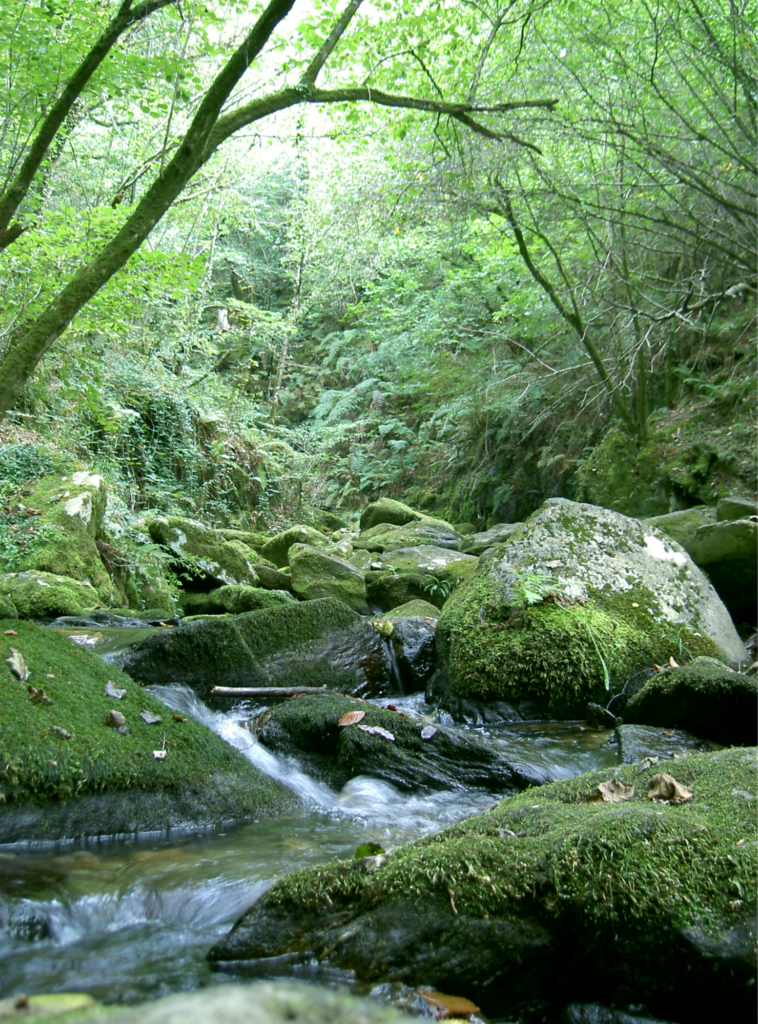
These forests don’t grow just anywhere. They require a very precise combination of conditions to survive and to thrive:
High environmental humidity: frequent precipitation and abundant rain throughout the year (in fact Galicia experience between 120-180 rain days per year);
Moderate temperatures: not too cold in winter nor too hot in summer;
North-facing slopes and deep valleys, where shade and sheltered terrain help humidity accumulate and linger;
Uneven, sloping terrain: many forests are found in areas of slopes or hills with uneven terrain;
Rocky outcrops: the presence of stones, boulders and exposed rock formations is common;
Soil rich in organic matter: a characteristic mulch of decaying leaves and wood covers the ground, providing nutrients to plants;
Presence of rivers and streams: fundamental to maintain the moisture of the ecosystem.
MGM_Photos, CC BY 2.0 , via Wikimedia Commons
What will you find inside?
The word fraga itself means “natural woodland”, an old-growth forest made up of many different tree species living side by side. Step inside one and you’ll find oaks and chestnuts, birches and alders, ash trees and yews, hazelnut trees and wild fruit trees, alongside perennial laurels, hollies and strawberry trees. Each species finds its own niche within the ecosystem. Cork trees, for example, tend to grow on south-facing hillsides — Galicia marks their northernmost limit in Europe. On the shadier, damper slopes, an extraordinary collection of lichens, mosses and ferns takes over.
As for the fauna, las fragas atlánticas are home to numerous and diverse species. Among its mammals, you can observe wild boars, foxes, feral cats and weasels, as well as birds such as the black redstart, peregrine falcon and great bustard. In its waters, the brown trout and the rainbow trout are the main protagonists.
Fragas do Eume
Fragas do Eume follows the course of the River Eume and spans over 9,000 hectares, making it one of Europe’s best-preserved Atlantic coastal forests. This area is a prime example of a temperate rainforest, where oak trees (Quercus robur and Quercus pyrenaica) dominate the landscape. In addition to oaks, there is a rich presence of chestnut trees, along with other species such as birch, alder, ash, yew, hazel, wild fruits, laurel, holly, and strawberry trees. The forest is home to 28 species of ferns and over 200 species of lichens. Furthermore, Fragas do Eume supports a diverse range of wildlife, including 103 species of birds, 41 species of mammals, and eight species of fish. It also harbors endemic species of invertebrates and reptiles, such as the Iberian frog.
Why should you care?
Temperate rainforests cover less than 1% of the Earth’s surface. They’re incredibly biodiverse, great at storing carbon, and yet most people have never even heard of them. In Galicia, the fragas are a living piece of history — forests that have looked more or less the same for thousands of years.