Wildcard Rewilding Conference 2026

How much rewilding is Europe ready to accept?

How much rewilding is Europe ready to accept? Reflections on passive rewilding, definitions, and the future of nature restoration.

Share This Post

Reflections on the Wildcard Rewilding Forum 2026

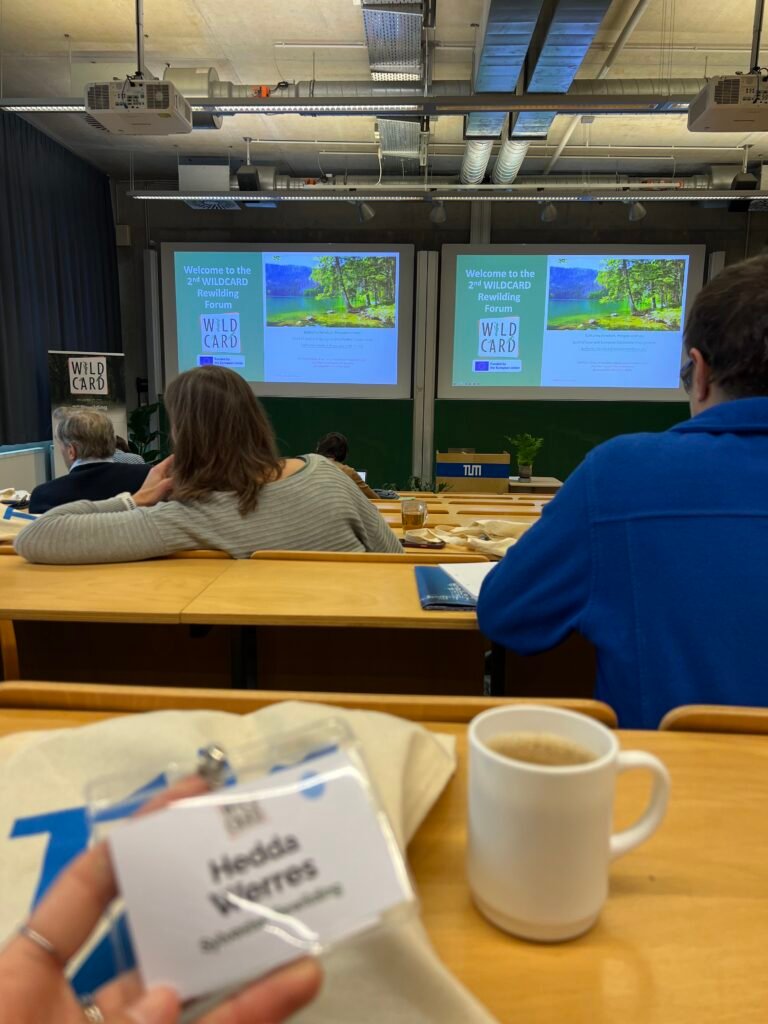
In February, the Wildcard Rewilding Forum 2026 brought researchers, practitioners and communicators to Freising, Germany, all circling around one deceptively simple question:

How much rewilding is Europe ready to accept?

The forum is part of the broader Wildcard project, which explores to what extent passive rewilding, letting nature regenerate through non-intervention, can help Europe meet biodiversity and climate goals. It sounds straightforward. Step back. Let nature lead. Watch what happens.

But as one might expect, nothing about rewilding in Europe is straightforward.

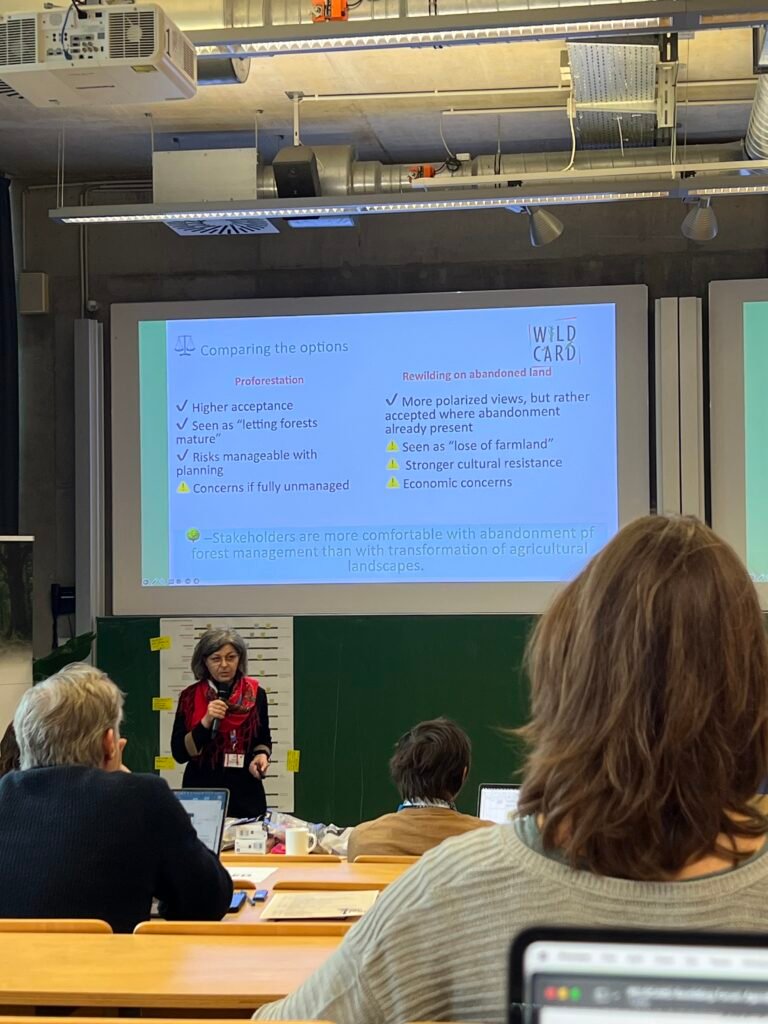
speaker at a rewilding conference

What is rewilding, actually?

It almost feels obnoxious to keep asking this question. Aren’t we here to talk about implementation? About scaling up action? About meeting the biodiversity and climate targets we are already late on?

And yet, again and again, the conversation circled back to definitions.

Before asking how much rewilding Europe can “accept,” we found ourselves asking what we actually mean by rewilding.

The term rewilding seems to be fluid. One of the early presentations on a study from the WildE project illustrated this well. Researchers wanted to understand how the general public perceives rewilding and distributed surveys across several European countries. But interestingly, they avoided using the word rewilding itself. Instead, they described the concept using country-specific terms that they believed would best capture its essence.

In doing so, they already acknowledged something important: the word carries baggage. It triggers different associations — some positive, some sceptical, some outright negative.

This fluidity seems to create a real challenge:

  • What do we label as rewilding?
  • Is it even important to label it?
  • How do we communicate it?
  • How do we anchor it in policy?
  • How do we measure perception?
  • And how does it differ from restoration or conservation?

Rewilding can look radically different depending on context. And while the community, also at this forum, may struggle to agree on a definition, one core idea usually remains: Nature leads.

But to what degree?

Passive rewilding: letting go, radically

The Wildcard project focuses specifically on passive rewilding: the deliberate decision not to intervene. No planting. No steering. No management. The assumption is that ecosystems can self-organise and regenerate if we step aside.

In theory, this makes sense. If humans disappeared tomorrow, ecosystems would continue to function or even improve and in many places, they would likely recover. Chernobyl is often cited as an example of how wildlife can rebound in the absence of people.

There is something deeply appealing about this idea. We know the scale of destruction we have caused. When you stand in a monoculture plantation or look at a drained wetland, the guilt can feel overwhelming. It’s hard not to think:

Wouldn’t nature just be better off without us?

The instinct to “give nature back what we took” is understandable.

But it is also incomplete.

Humans are not separate from nature. Especially in Europe, a continent shaped by centuries of agriculture, settlement and land use, the idea of removing humans entirely becomes almost abstract. There are very few places untouched by our influence.

Most rewilding practitioners in Europe recognise this. Their work is not about erasing humans from ecosystems, but about dissolving the artificial boundary between “nature” and “society.” Rewilding becomes less about absence and more about coexistence, restoring ecological processes while acknowledging that people are part of them.

It may sound idealistic, maybe even slightly spiritual, to say that humans are nature. But in practice, rewilding always operates at the interface of ecology and culture. It reshapes how land is used, how communities relate to it, how economies function and how people identify themselves with the landscapes.

And this also applies to passive rewilding, whether we like it or not. Leaving a site untouched still affects the communities around it. It influences local identity, land use debates, economic expectations.

Rewilding is never just about land. It is also about people.

The spectrum of rewilding

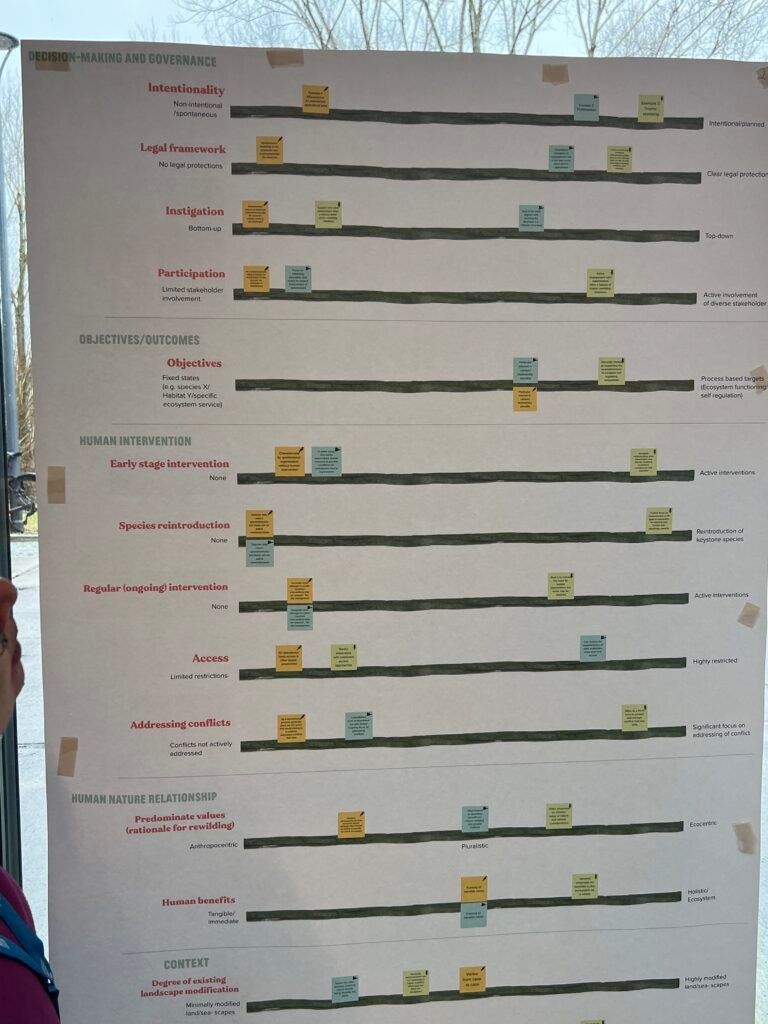
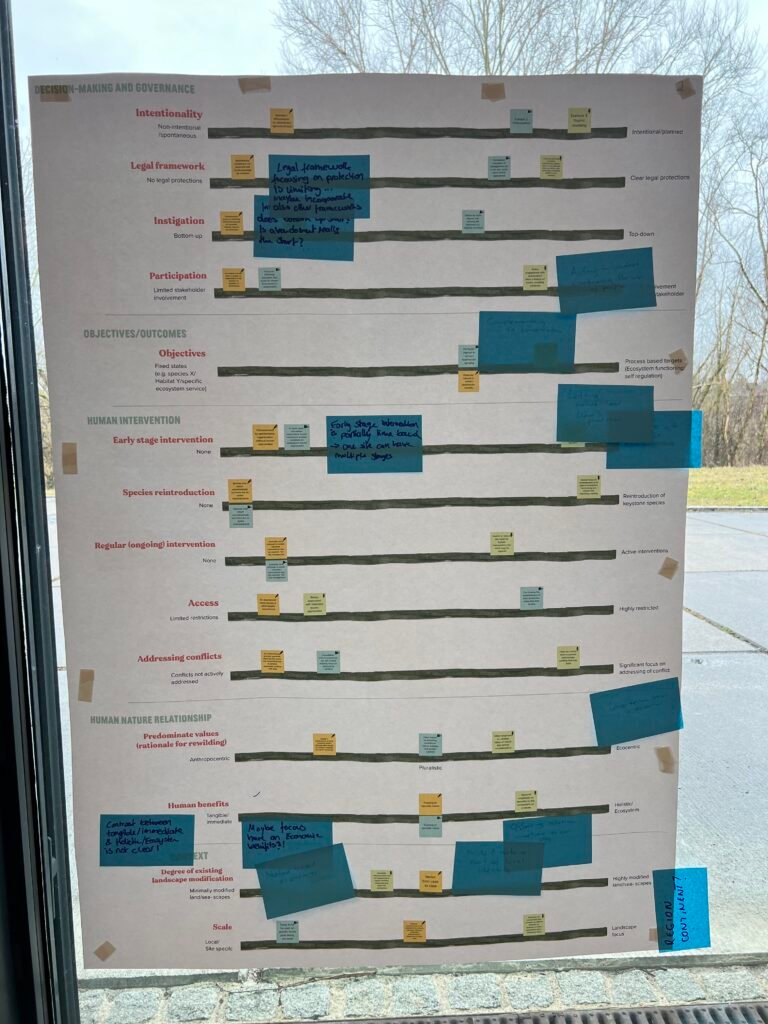
This multidimensional nature of rewilding was reflected in the “rewilding spectrum” developed in earlier Wildcard workshops. The idea is to evaluate projects along different scales, participation, intentionality, legal frameworks, conflict management and more, in order to make the concept more measurable.

It is an honest attempt to bring structure to something that often feels slippery.

One of the first exercises at the forum was to annotate and critique these scales. Many participants suggested that the human dimension could be integrated even more strongly. Questions of ownership, livelihoods, identity and justice kept resurfacing.

These early debates revealed something important:

Perhaps the real question isn’t how much rewilding Europe is ready to accept.

Perhaps it’s what type.

how to measure rewilding scale
how to measure rewilding scale adjusted

A 25-hectare island of wilderness

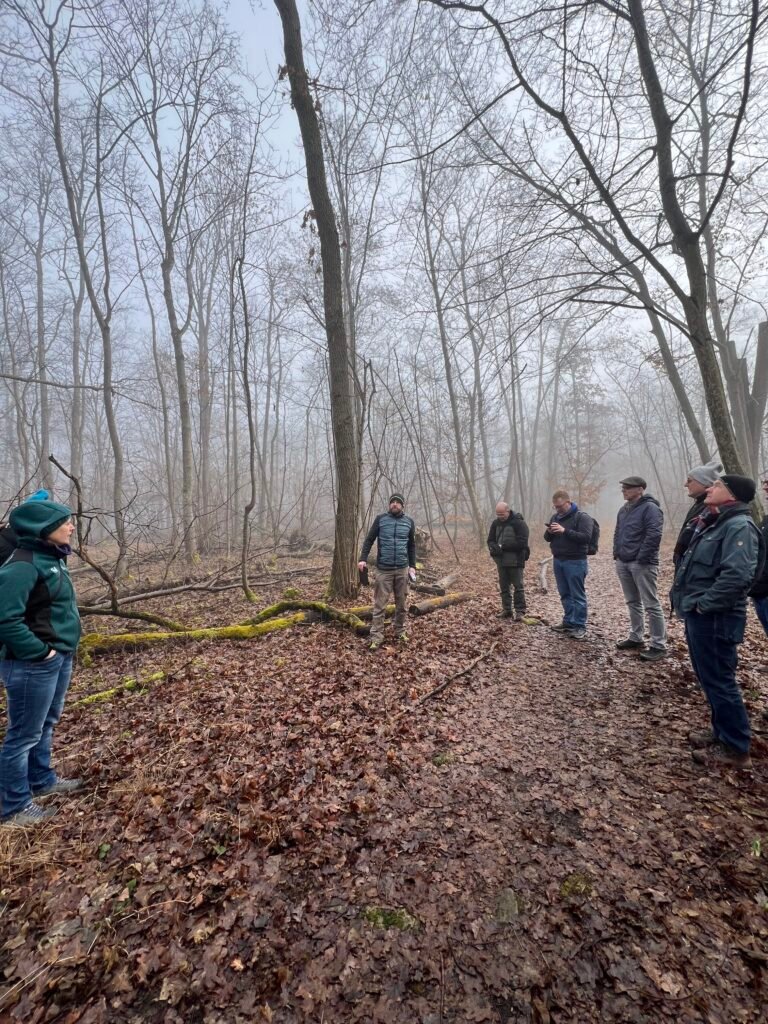
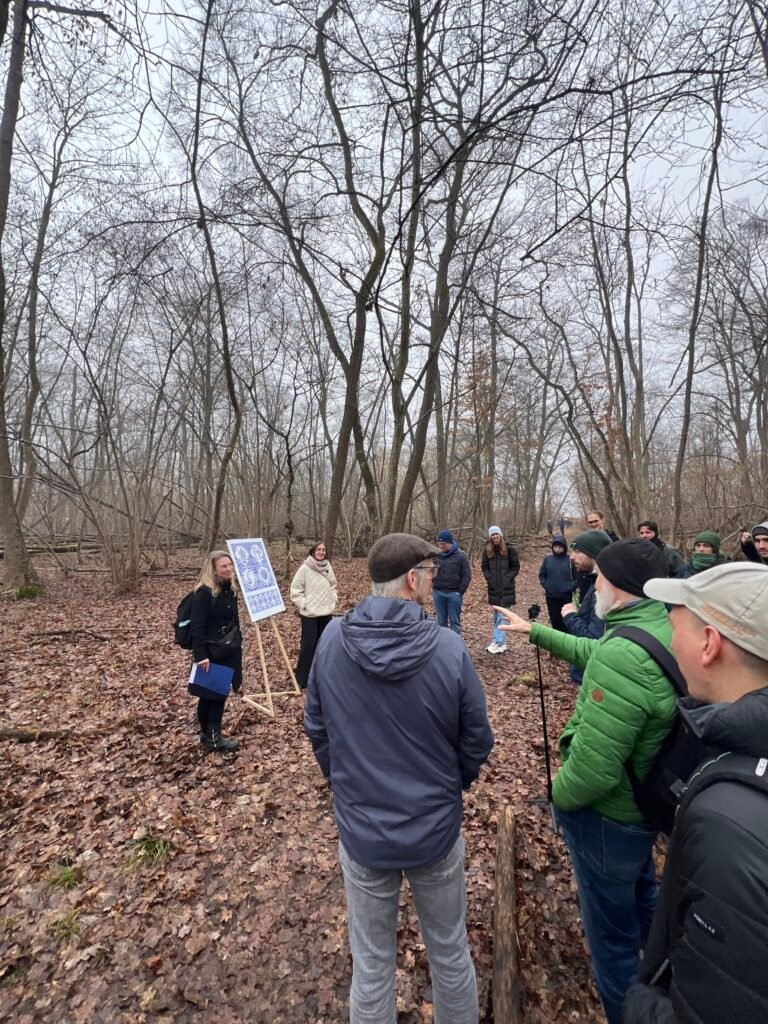
On the second day, we visited the Wildcard pilot site near Freising, 25 hectares of forest under passive rewilding. No intervention. Researchers simply observe how succession unfolds.

It is fascinating. You can literally see ecological processes reshaping the space.

The data collected here feeds into modelling efforts that explore how Europe might look if larger areas were left to regenerate naturally.

And yet, standing there, a tension becomes obvious: The site is an isolated island, surrounded by agricultural land and highways. It exists within a heavily shaped cultural landscape.

How “natural” can a place really be when embedded in such a matrix of human activity?

And can this approach realistically be scaled across Europe?

These are not arguments against passive rewilding. They are questions about context.

group in forest

Abandoned land and uncomfortable realities

Across Europe, rural land abandonment is accelerating. In many regions, landscapes are already “rewilding themselves.” On paper, this might seem like the perfect setting for passive rewilding.

But does it work like that in practice?

Nature may return, but does it return in time? Or would a helping hand from humans buy us crucial decades?

And is it ethically sound to damage a landscape and then simply walk away?

In southern Portugal, abandoned eucalyptus plantations raise exactly these questions. Left alone, the eucalyptus, introduced and planted by us, continues to dominate. Native species struggle to return. The monocultures increase fire risk and threaten nearby communities.

In such cases, non-intervention does not automatically mean recovery.

So what is the value of passive rewilding

Large-scale non-intervention may be unrealistic in densely populated regions. But passive rewilding sites could still offer important insights:

  • How ecosystems respond without direct management
  • How indirect human pressures, CO₂ emissions, agricultural runoff, fragmentation, continue to shape “untouched” areas
  • Which processes recover naturally and which remain blocked


For example, expanding deer populations in fragmented landscapes can prevent forest regeneration. In such cases, complete non-intervention may not lead to desired outcomes. Passive sites can help identify where active rewilding is needed to re-enable processes that are blocked because of human activities.

There is also a psychological dimension. Exposure to unmanaged landscapes raises questions: What do we perceive as beautiful? What feels threatening? What do we consider “healthy” nature? Public acceptance is shaped not only by ecology, but by aesthetics and emotion.

At the same time, the idea that large-scale passive rewilding alone could deliver Europe’s climate and biodiversity targets deserves critical examination. Land in Europe is owned, farmed, inhabited and economically embedded. Any strategy that ignores this reality could face serious resistance.

A cultural shift, not just a land-use strategy

What became clear throughout the forum is that rewilding in Europe is as much about culture as it is about ecology.

Many practitioners are not aiming for human-free landscapes. They are working toward a shift in perspective, from seeing nature as something external and competing with us, to recognising it as the foundation of our existence. In this framing, rewilding is not about abandonment. It is about redesigning relationships.

While the heated debates around definitions can feel like we are circling without getting to action they also showed that the movement is alive, exploring various rewilding approaches, questioning itself, refining its language, trying to articulate what it stands for.

In that light maybe the real question is not how much rewilding europe is ready to accept but how much we are able to rethink our place within nature. 

Author

SYLVESTER