What happens when young people return to the land? From disappearing fireflies to communal forests and rural loneliness, this piece explores why Galicia could become both a climate refuge and a laboratory for collective futures.
Share This Post
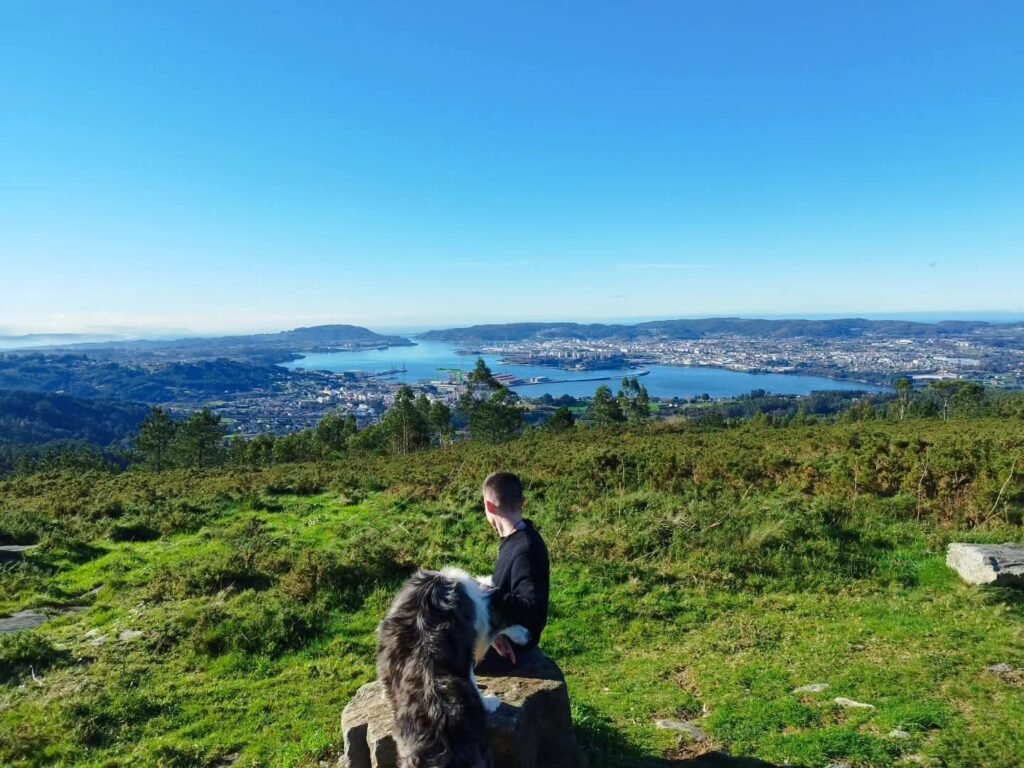
I grew up in a Galician village of 300+ on a hillside above Ferrol. Every morning and every evening, the birds sang. The hills were impossibly green and lush. Below, the Ria de Ferrol opened out into the wide mouth of the Golfo Artabro, where the estuary meets the Atlantic. Blinding like a jewel when hit by the sunlight. You don’t think about any of it when you’re small, It’s just the sound and feel of being alive. But it definitely registers.
Then you leave. Like most young Galicians, I was constantly encouraged to. International studies, work, the Brussels EU bubble. Years of trying to change things from inside the rooms where decisions get made. I believed in it. Until I didn’t. Until the double standards and the divisiveness and the exhaustion of watching the planet burn while institutions argued about procedure and appearance, wore something down in me that I didn’t know how to name.
Coming back to Galicia (even just for stretches, even still living between worlds) felt like the land receiving you with open arms. Nature as medicine. That’s not a metaphor. It’s just what happens when you sit under a walnut tree overlooking a sunset long enough. No need to produce, nothing to weigh your “value” against. No performance.
In 2025 I started planting native trees on a small plot. Carballos, acivros, bidueiros. There is a simple, grounding clarity in taking matters into your own hands. And I joined Sylvester Rewilding, who are doing something rare here: actually listening before acting. In a world obsessed with “scaling up” and “disrupting,” Sylvester feels like a sane corner of the world. They aren’t interested in the performative environmentalism I saw in Brussels; they are focused on the slow, painstaking and deeply necessary work of restoration.
Showing Up
Through the Bridging Movements project, we posed a simple question: what are Galician youth connected to rurality actually living, and where might bridges to the environmental and social justice movements be built?
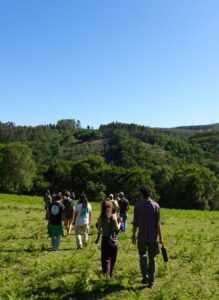
We quickly learned there are no rural youth organisations in Galicia. No youth environmental networks to plug into. So we went directly to two vocational training centres (forestry students in Mugardos, landscaping students in Guisamo) and held a third session online. We went to listen.
What struck me from the start was the openness. There was a readiness to talk and share that felt profoundly different from the professional networking I’d grown used to. It’s a specific Galician quality: the same one that led two students to walk us over to the greenhouse as we were leaving. They simply picked two lettuces and handed them to us. No ceremony, no performance. Just earth still on the roots and a quiet: “Take these!”
What We Found
These young people were already completely knowledgeable on the topic. That’s what hit us.
Climate change wasn’t abstract to them. It was the fireflies disappearing. Trees flowering in November. Fields flooded when they should be ready for the hay season.
“It’s not normal and we don’t know what to do.”
The primary sector (farming, forestry, the work of actually tending to land) is being strangled. By regulation, by economics, by a system that makes sustainable small-scale production impossible while pretending to care about sustainability.
“It’s reached a point where it doesn’t even pay to work the land.”
But the thing that came up in every single session, the thing that stayed with me most, was loneliness. The lack of community. The sense of shouting into a void.
“Before, you had a problem and a party was thrown to find solutions. Now, I feel like I have no one to tell my problems to.”
Everything is in crisis. That’s what it felt like in those rooms. Ecological crisis, economic crisis, social crisis — all the same crisis, wearing different faces. And underneath it, people who care enormously, with nowhere to put that care.
By the end of each session the energy had shifted. People were exchanging further thoughts, asking for follow-up activities. Someone said: at least we are now in contact. That gives a bit of hope.
That’s not nothing. That might be everything.
The Dead Forest
Everyone in Galicia knows the eucalyptus. Millions of hectares of a tree that doesn’t belong here: planted for the paper industry, burning faster than native forest, silencing the soil beneath it. You walk through one and feel the absence. No birds. Nothing moving. The Earth calling for help in the only language it has left: silence.
But Galicia still has memory. The ancient Atlantic forests. The turbeiras, peat bogs storing more carbon than anyone gives them credit for. The montes en mancomún, communal land that survived centuries of pressure. The knowledge of how to live with land, not just on it, still carried in families and villages, frayed but not gone.
I think Galicia is the new frontier. Not in any colonial sense, but the opposite. A place that could become a climate refuge and a laboratory at the same time. As a refuge, our peat bogs and ancient Atlantic forests are carbon vaults and biodiversity strongholds that much of Europe has already lost. But as a laboratory, Galicia offers something even rarer: the montes en mancomún. This system of communal land ownership, which has survived both private greed and state control for centuries, is the perfect testing ground for new models of social and environmental justice.
In this laboratory, we aren’t just testing soil; we are testing resilience. We are experimenting with how traditional village wisdom can hybridize with modern technology so that working the land isn’t an act of martyrdom, but a viable, connected life. It is a space for Europeans to move past ‘tourism’ or ‘nostalgia’ and become active stewards of a beating ecosystem. It is where we remember what it means to live as part of the living world, rather than simply standing on top of it.
Otherwise we are looking at full death. Not metaphorically.
The Future
A bird that flies across the entire world still comes back to the same tree in spring. Imagine understanding the world well enough to do that. Imagine trusting it.
The future is rural. The future is communal. It is understanding across every possible divide: language, generation, culture. It is mending the relationship with land and with nature. It is, sometimes, non-verbal. It is carrying in your car trunk two lettuces someone has just given you, and knowing exactly what they mean.
Sylvester is now working to turn the connections made in these sessions into a Motor Group: rural Galician youth with a shared space, shared purpose, and at least one piece of land to begin restoring together. It is a small beginning. But all forests start that way!