What began as collaborative research with young Galicians became something much bigger: a grassroots youth assembly rooted in community, rewilding, and a shared vision for a new rural future. Discover how 21 young people came together in Mañón to reconnect with the land and turn isolated voices into collective action.
Share This Post
In May, I wrote about leaving a high school research visit with two random lettuces in the trunk of our car.
This September, the car trunks came full of help and kindness. Twenty-one young Galicians arrived at an ecovillage in Mañón, five people in a car, packed tightly with tents, extra sleeping bags, and mattresses. No one was left behind. In a landscape often defined by what has been abandoned, everyone was provided for. And it was not due to perfect planning and funding.
We really did not expect that. This piece explains how we moved from those initial raw, wholehearted truths during the collaborative research to a living youth assembly, driven by a refusal to remain isolated islands and a deep yearning to find our place back in the loop.
What Collaborative Bottom-up Research Gave Us
Short excursion between community research session back in March.
For those who missed the first piece: throughout March we sat down with forestry students in Mugardos, landscaping students in Guisamo, and a third group of young people online. We didn’t go to teach or to propose anything. We went to ask what it’s really like to be young and connected to the land in Galicia.
Some 30 participants told us about the fireflies that used to be everywhere. About trees flowering in November, and fields flooded in hay season. About farming that has become a slow suffocation. One of them told us you’re forced to use chemicals because they won’t let you use the manure you naturally have. Nobody there thought of climate, land, money and culture as separate subjects. For them, it was all one question: who gets to stay in the village and the forest, and who has the final say in what happens to it?
And under all of it, again and again, loneliness. Concerns that were shared, but scattered, each one on its own island. One group named what was missing: a grupo motor. A few people on the ground to turn ideas into something real.
At the end of each session someone said some version of the same quiet thing: at least now we’re in contact.
That’s when we knew the report could not be the end. It had to be a meaningful new beginning.
The reclaimed word
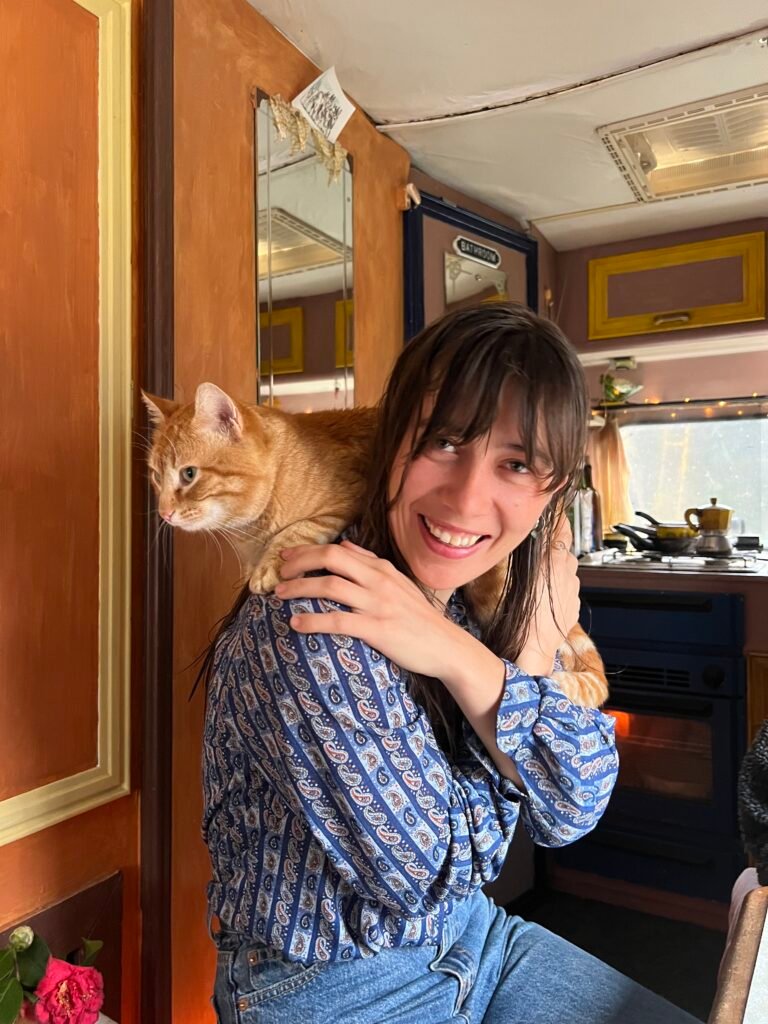
Julia and her questionable feral cat Freddy hosting us during the community research in Galicia.
Once further funding from Youth and Environment Europe was secured, we called the next stepAsilvestrados.
It’s an old Galician word, and by all means not a flattering one. It just so happens that Rewilding has no real translation in Galician: English gave us the term, Spanish offered a handful of awkward ones, and we were left to either borrow an “anglicism” or reconceptualise. So I reached for something naturally Galician, and turned it around. Not wild as in lost. Wild as in returned.
I think of how it has always been in my own small village when a house cat slowly slips away and becomes feral. The relationship changes; the easy everyday trust fades, replaced by a careful, distant respect. Yet, the intrinsic nature of the cat remains entirely unchanged, and its true place within the ecosystem is never lost: it is simply reclaimed.
Somewhere along the way, we are the ones who lost our true place in the ecosystem, trading our belonging for a tamed, extractivist, detached existence. To balance the scales, I felt we also needed to find our own way back. To rewild our lives at both the individual and the collective level, quietly rebuilding that lost connection and reclaiming our position within the living world. Before the weekend, one participant wrote that they wanted “to reconnect with what we should never have left behind”, so “Asilvestrados” was our attempt to open the way.
Five to a car
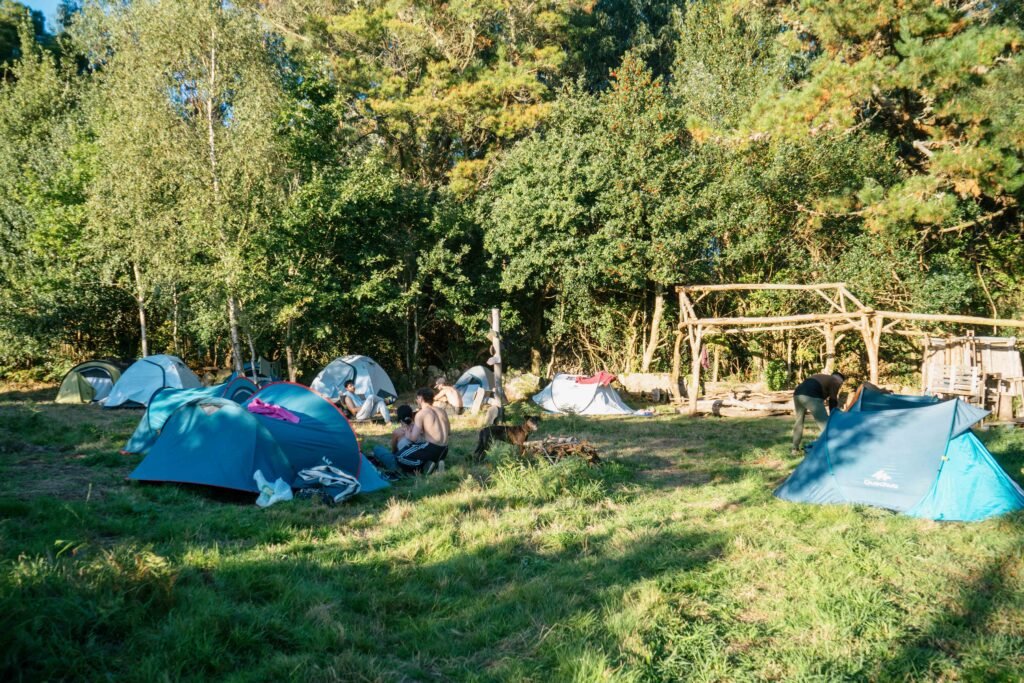
Setting up the camp.
The ecovillage of O Cadaval can only be reached by car. Forty minutes east of Ferrol, an hour and a half from A Coruña, which is as far as the train really takes you. For a young person without a car, that’s a closed door, and everyone in Galicia knows it.
We had initially budgeted for ten, perhaps fifteen participants. But when the call went out, the responses came back raw and heavy with purpose. People didn’t just register; they told us why they needed to be there. They spoke of the suffocating paralysis of watching the planet burn from behind a screen, of shouting into a digital void with no community left to face the echo. “Right now I feel we are small islands,” one wrote, “and to be resilient we need community and cooperation.” When we asked them what they wanted to bring back, they answered like it was a matter of survival.
Saying no felt like a betrayal. It was only honest to say yes to everyone we could, so we carried the financial and logistical risk ourselves.
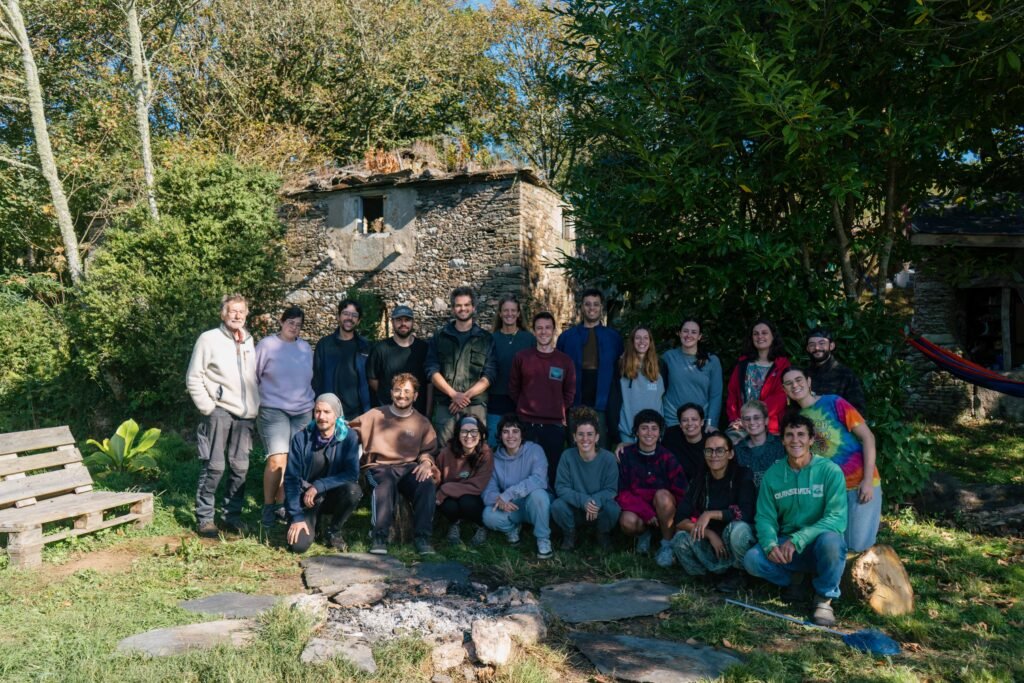
Then, the unpredictable happened. Total strangers began organizing on their own. People offered up their cars, filling them to the brim with tents, sleeping bags, and people they had never met. Nobody was left behind. In the end, twenty-one participants aged 20 to 35 arrived, converging from every single corner of Galicia.
Trees and hands first
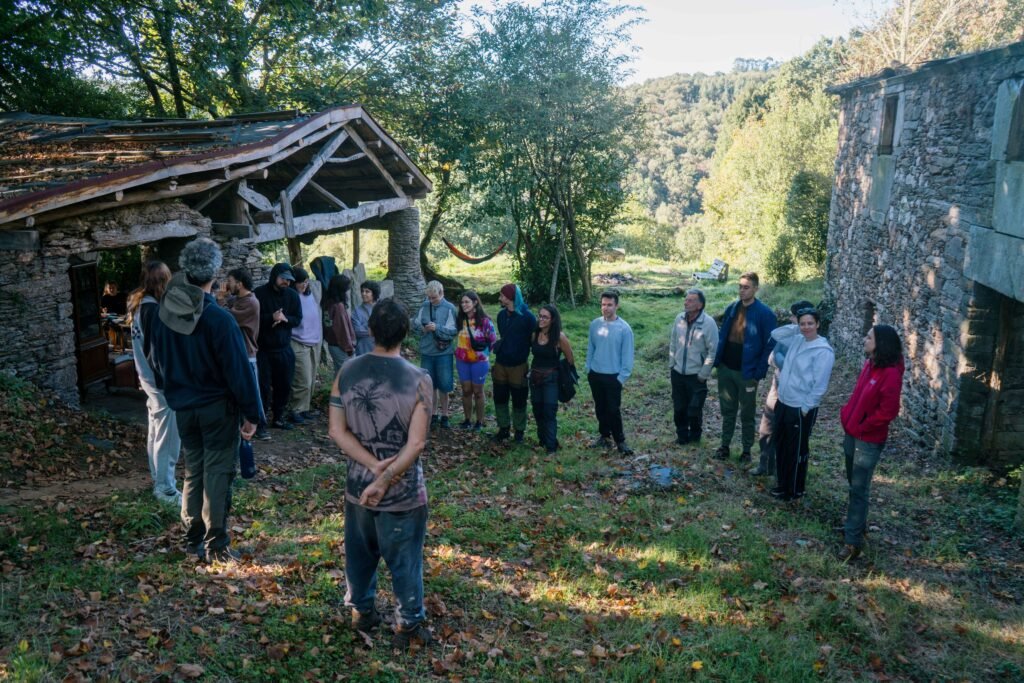
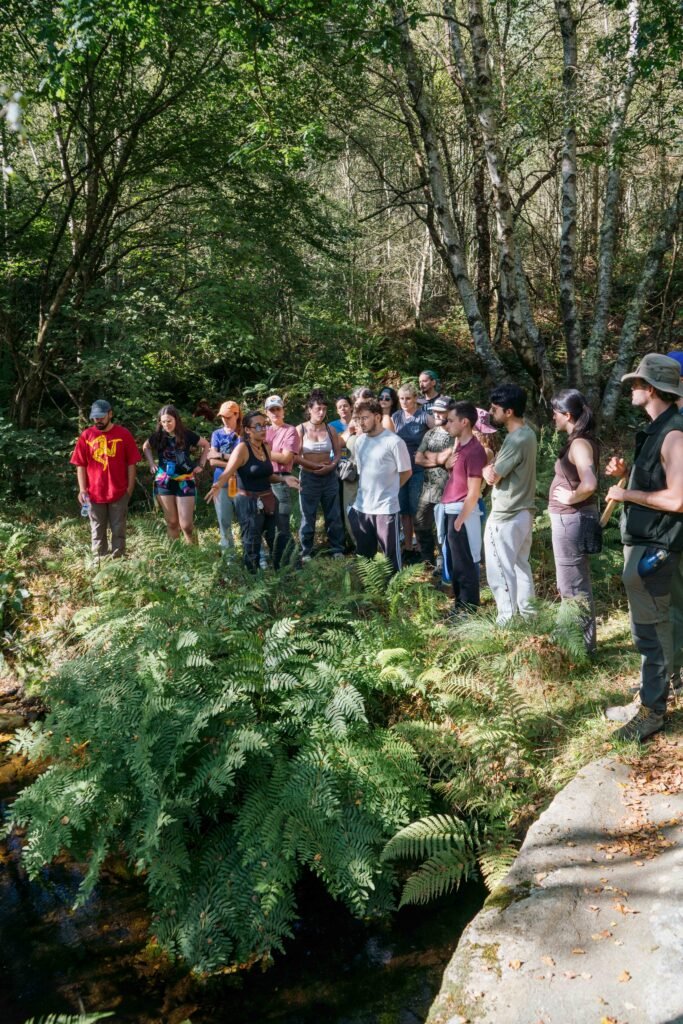
Starting the Aldeia tour.
On Friday night most of them did not know each other. By Sunday, they had established a coordinating group.
What we confirmed that weekend is that people talk more earnestly and groundedly after having shared a natural space as a group; compared to a linear, four-walled, artificial enclosure. Together, we walked through the permaculture garden carefully tended by Walter, and handpicked vegetables to be used in the groups’ meals. Together, we walked around the ecovillage project and witnessed how its history was carved directly into the landscape: listening to how Manolo started from a cluster of abandoned stone houses with trees breaking violently through their walls, to the living sanctuary it is now. Together, we sat down in a circle and listened to Hanna and Julia’s life story and how their wish to break with consumeristic and extractive cycles and to embody a nurturing, regenerative and sustainable life brought them all the way from Germany to Mañón. And also together, through the biosensitive expert eyes of Elena, we looked at Sylvester’s rewilded plot, counted its biodiversity, and spotted the eucalyptus already trying to come back, which it always does. One participant had earlier put it this way: “It’s a eucalyptus forest that they still call a pine grove”
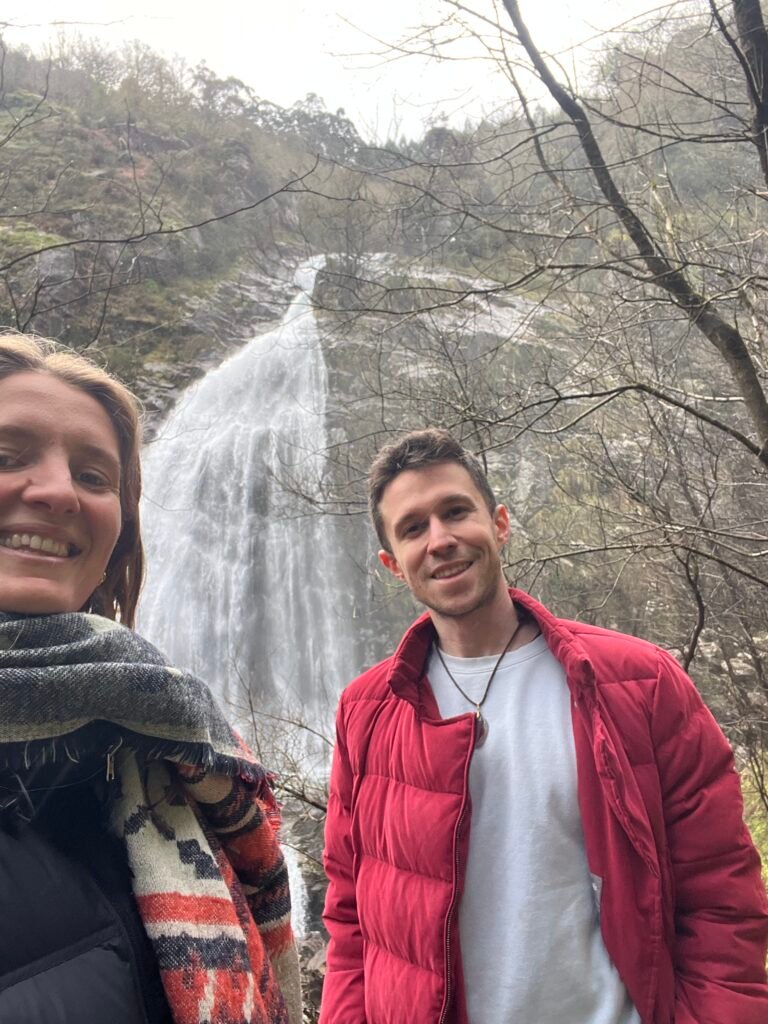
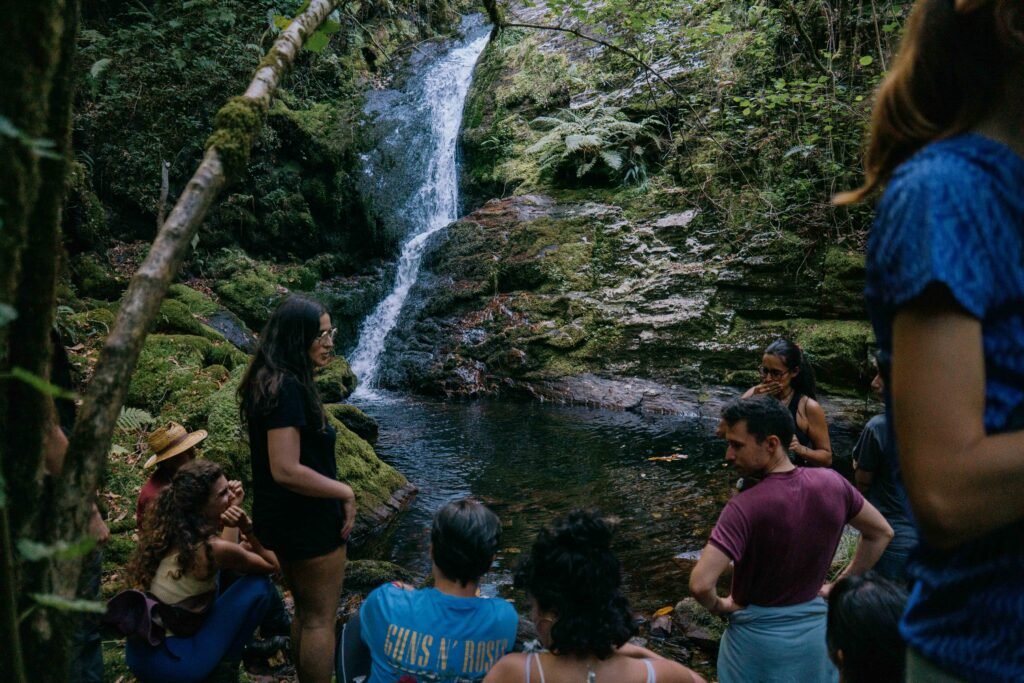
On this last hike, the group carried on following downstream the regato (creek) surrounding the aldea, and inadvertently treading centuries-old paths, we all ended up at a waterfall. It wasn’t on the programme, but by the end there was a spontaneous “spa” moment where we sat down to listen to the waterflow, and several participants dove in without much afterthought about the hike back. Yet I am convinced these types of “freeing” moments do more wonders to integrate us as merely one thread of one big ecosystem than any amount of roundtable talking ever could.
The Start of the Galician Rural Youth Assembly
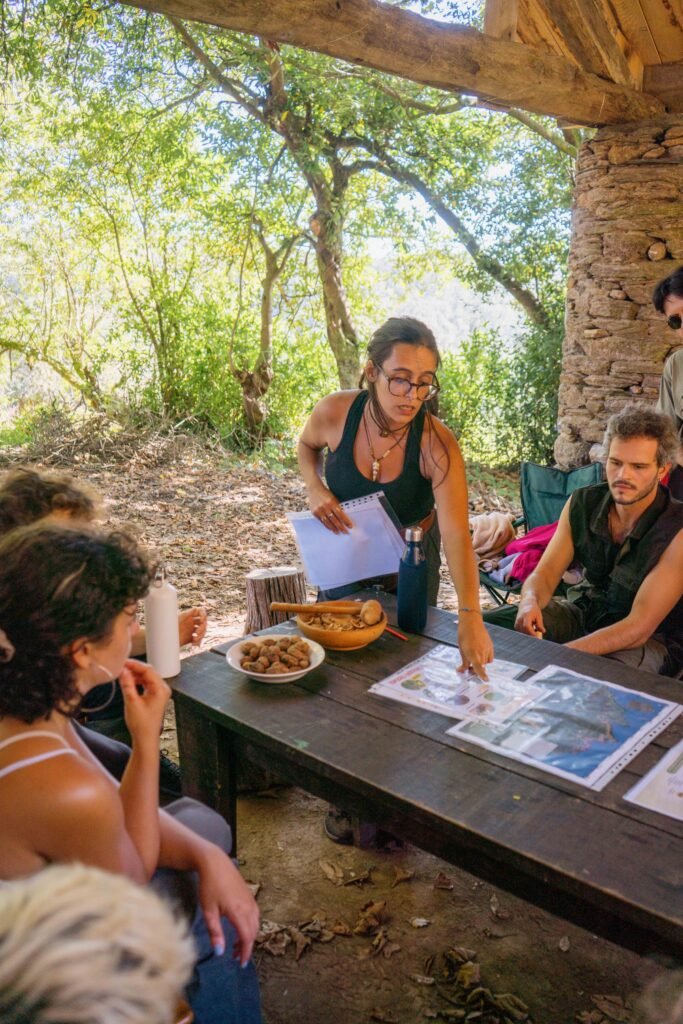
Elena hosting our rewilding workshop
Rewilding Workshop excursion
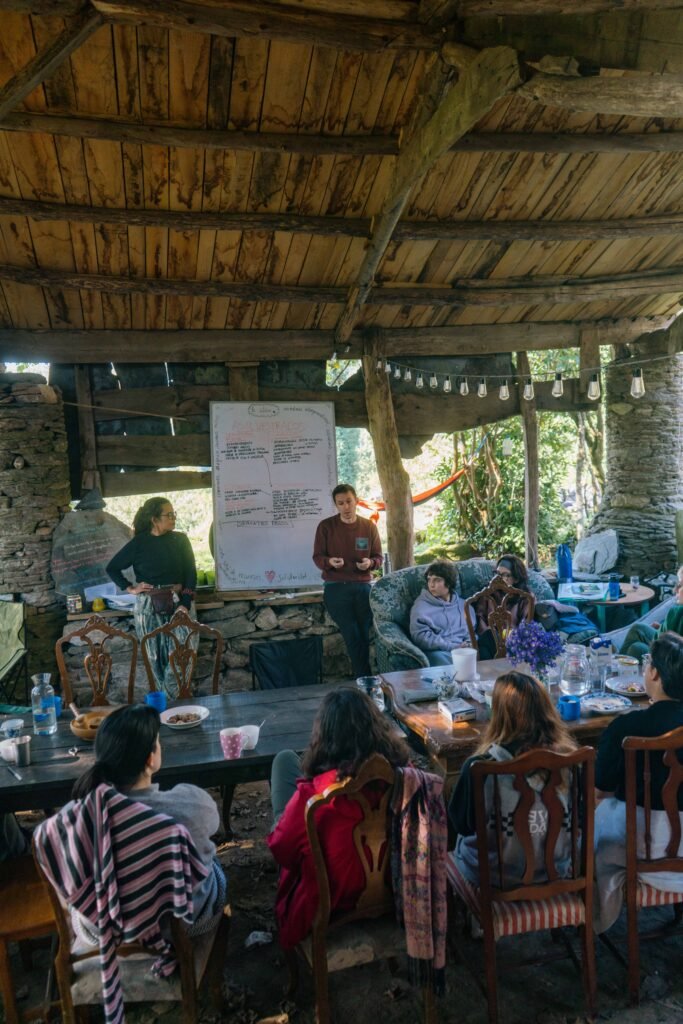
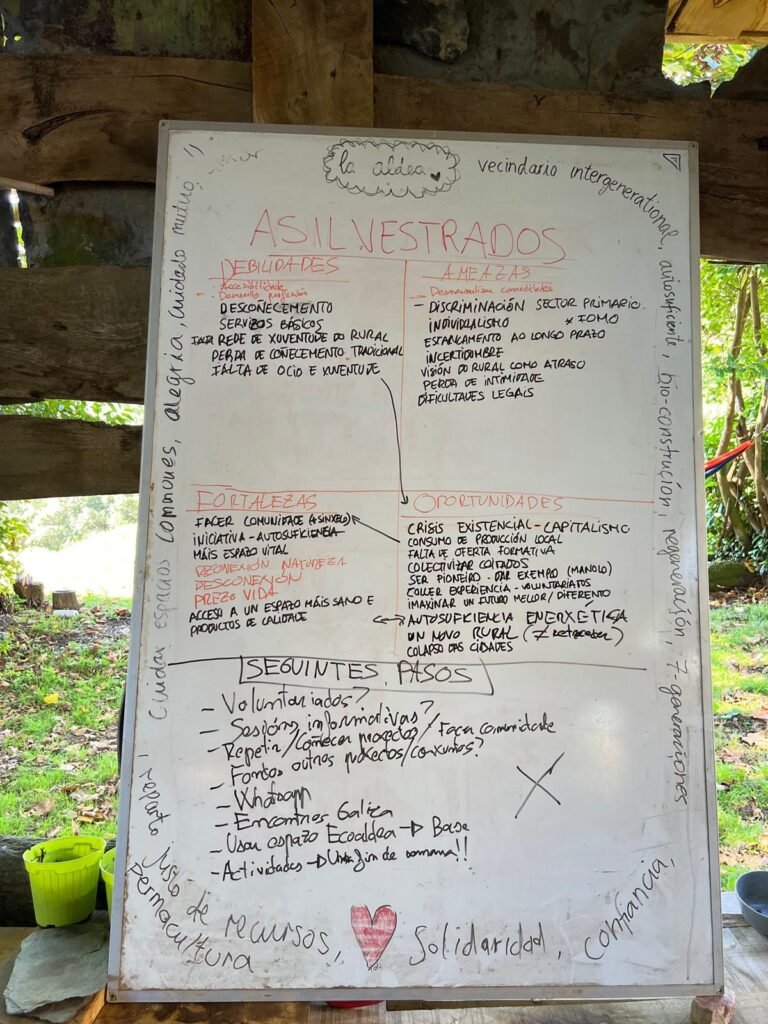
On Saturday evening, after the hike back from the waterfall, we sat down for the first part of the assembly. The group, from what was written individually after Hanna and Julia’s workshop introducing the It’s Thyme Hope Hub initiative, built a SWOT analysis on a whiteboard. I’d like you to see what it says (on Elena’s and my questionable handwriting) because it’s what I’m proudest of. Definitely we had foreseen that compressing worries, frustrations, and deep yearnings for change into a divided box like this would be a straining task, but we still wanted to try. And once again, the group surpassed all expectations.
Right away, under the weaknesses, we unearthed again what we’d heard in the spring: desconhecemento, no youth network in the rural, tradition fading. Under the threats, one line that stopped me: visión do rural como atraso (Rural life as backwardness). It was not new, rather a generational indoctrination which every concerned young Galician has fought against its whole life. In their applications, one participant had written: “We need to stop talking about the rural only in terms of abandonment or problems, and start valuing the people, initiatives and alternatives already creating new ways of living, caring and relating to nature.” A positive communal spin.
Then suddenly an arrow was drawn. It ran from “nothing for young people to do” across the whole board and lands on the first strength: facer comunidade. Making community. Nobody planned that arrow. It’s just true for every Galician that feels the call to protect life on the planet.
And in the opportunities box, one line marked with a small, firm sign: un novo rural (≠ retroceder). A new rural space. Not a step backward.
That’s the sentence I’d put in a frame. None of us young Galicians is asking to go back to some imagined village, and turn our backs to both the advancements and the issues humankind faces as a whole. What we want is to build something outside the ever-grinding extractivist wheel, with Nature as its centre and us in it, weathering the storms to come.
Hand to Hand
Hike to the waterfall
On Sunday morning we finished with the next steps. Volunteering. Information sessions. Starting projects, repeating what worked. A WhatsApp group to bridge our isolated islands. Using the ecovillage as a base. And the last line, with two exclamation marks: Actividades → un fin de semana!! (another weekend as soon as possible!).
That same morning they decided to form a coordinating group. It’s the beginning of the grupo motor someone asked for in the spring. They’ve already asked about their own meetup, possibly back at the ecovillage, even if funding is scarce and resources would have to be pooled again. This whole time, I think it is important to highlight, conversations had been developing simultaneously in Galician, Portuguese, Spanish, English and German, often in the same sentence. Everyone shifted their listening centre from the ears and the brain, towards the heart. Languages and cultural differences seemingly becoming secondary, almost as if Nature itself was suddenly given 21 voices to decide collectively on the best future possible for the land.
That’s not Sylvester, a grassroots organisation, leading anymore. That, I am sure, should be the real point of collaborative research and bottom-up approaches.
After the assembly closed, a few participants went to help Manolo move slates for the new village roofs. Nobody announced it. Talk simply turned into action, stone to stone, hand to hand, and somewhere along that chain, at least looking in from the outside and within the short space of two days, a group of strangers stopped being strangers.
The future
Asilvestrados Assembly
Asilvestrados Brainstorming
There is an old communal cosmovision deeply rooted in Galicia, visible in our thousands-of-years-old spiraling petroglyphs, and the wheeling cyclical formations of the muiñeira, that reminds us we are merely a single turn in an everlasting loop. It is a lifestyle that resisted empires and survived centuries of extractivism through ancestral natural entities like the montes en mancomún, and through an invisible network of mutual help and exchange. The applicants described the break in that chain: “In the years since our grandmothers’ generation, we normalised not knowing the names of the trees and birds we see every day, not knowing our neighbours, not knowing where most of our food comes from.” And one described the wish to rejoin it: wanting to live in the rural “not just to live there, but to live and unearth the ways people lived there.” When we sit at the table today, we aren’t borrowing a future from strangers; we are carrying forward a collective bond with the land that has already rolled through the ages and will keep flowing long after we are gone. This, of course, unless humankind collectively fails to find its way back to a regenerative life in community, continuing to split itself down the middle until the very last livable place on Planet Earth is blown away into dust, scattered, and forgotten.
Twenty-one people. A camping weekend, a board that ends with un fin de semana!!, a stack of slates, a waterfall nobody planned. Isolated on our own separate islands, it might seem small. But the people who planted the forests whose shade we rest under today didn’t do it for their own comfort: they did it for the ones coming next. For us.